Carefully Taught

Hi all, moving forward I’ll be using the blog feature of this website more selectively in lieu of a new monthly newsletter, which I’m calling Carefully Taught, the working title of my book in progress.

Please sign up for a free subscription here – hope to see you there!

Mother Denise and the Hula-Hooping Nuns

“Rarely does one find in one woman both an expert primary teacher and discerning business woman. Add to that combination spiritual leader, public relations woman, adept seamstress, and furniture mover, and you have one woman, Mother Denise Mohr.” Oklahoma Courier 47, No, 20, June 16, 1967

As best I can recall, the black and white photographic image–so powerful that it managed to achieve pre-Internet virality–first came to my attention when I purchased it in postcard format when living in Washington DC in my mid twenties. Like many who have encountered the image, I was drawn in by its joyful incongruity: nine nuns in black head-to-toe habits smiling and clapping as one of their fellow sisters swivels her hips to keep a hula-hoop from hitting the ground. The garments of the nine sisters hang straight down to graze the tops of their shoes, in contrast to the central figure of the hula-hooper, whose elevated arms and gyrations have caused the voluminous material of her habit to catch air. She’s not quite a flying nun, but she seems poised to take off like a helicopter, or maybe be assumed body and soul into heaven like the Blessed Virgin Mary.

My connection to the image, however, ran deeper, as I would subsequently learn. At the time I was still a practicing Roman Catholic and also still somewhat newly out of the closet, and like many non-hetero Catholics was awkwardly trying to balance those dual identities. Like the campy fictions of the Sister Act film franchise, the image contained the possibility of the unconventional amid the hierarchies and strictures of the Church. Most important, when I saw the postcard in the store I immediately knew the person who I needed to send it to: Denise Mohr, a longtime friend of my family who had been my second grade teacher, and a former member of the Benedictine order.

Knowing what I know now about Denise, I should not have been surprised when I eventually spoke to her about the image. She somewhat casually revealed that yes of course she had seen this picture before, because she was one of the nuns in the photo, the fifth from the right to be precise. 

Denise was born on Easter Sunday in 1924 and passed away on April 18, two days before what would have been her 100th birthday. Her physical decline was swift, and she never experienced any mental diminishment. In November 2023 Denise and I emptied two generous glasses of red wine in her airy apartment in South Tulsa. It turned out to be our last time together. 

***** 

“Your way of acting should be different from the world’s way; the love of Christ must come before all else. You are not to act in anger or nurse a grudge. Rid your heart of all deceit. Never give a hollow greeting of peace or turn away when someone needs your love.” Rule of St. Benedict, 4:20-26

Denise was a presence in every sense of the word. In one-on-one interactions, she spoke as if you were the only person who mattered, inquiring into your life with motherly warmth and commenting with beatific clarity. She was also a presence writ-large in the Catholic community of Tulsa, Oklahoma, and in particular the parish where I was raised, the Church of St. Mary. While the Bishop’s seat changed its occupant and priests came and went according to the whims of the Diocesan authorities, Denise was an abiding presence. For many years she held official positions at St. Mary’s, as an elementary school teacher at its affiliated school (where I was one of her students) and later as a director for religious education. 

But Denise transcended any official role, reflected in the different names and titles she held during her life. She was born Mary Catherine Mohr, and was especially proud that her large Kansas farm family were descendants of Joseph Mohr, the composer of “Silent Night.” When she became a Benedictine nun she took on a new set of names, becoming Sister Marie Denise. In late 1960 she underwent another yet another change in her name, when she was put in charge of St. Joseph’s Convent in Tulsa, becoming Mother Marie Denise, or Mother Denise for short.

This promotion was not something Denise had actively sought, and she was reluctant to take up the position as she had not been a member of St. Joseph’s, having been part of the Convent of Christ the King in Oklahoma City. But the directive had come from Rome, with the previous prioress asked to step down in part due to mounting debts that had accumulated in the community. Denise held the title of Mother for not quite seven full years, when she was abruptly removed from the post in June 1967.

An article published in the wake of her forced resignation noted how her assuming the title of Mother had been something of a prophecy fulfilled, albeit in an oblique manner. When Denise was in first grade, a religious Superior had visited her class and asked the children how many wanted to become priests or nuns. Denise declined to raise her hand, and when interrogated about her decision reportedly replied: “I just want to be a mother and have lots of children.”

Although she never bore children of her own, Denise had firsthand experience with motherhood as the oldest of eighteen children. (I’ll pause to let that statistic sink in since it never ceases to give pause to me or anyone else I relate it to.) For her and other women of her generation, joining a religious order was a way of pursuing a vocation while also sidestepping familial pressure to marry and have children. And yet Denise still ended up Mother to hundreds if not thousands over the course of her life.

Her continued work as Mother was not undertaken alone, however, but alongside her roommate and friend Glenann Wilkerson, who like Denise had managed to carve out an independent life that transcended humble rural origins and contemporary expectations for women. Glennan moved from her hometown of Welch, Oklahoma to Tulsa and took a job working for the local insurance mogul Ray Siegfried, and like a midwestern Peggy Olson slowly worked her way up the corporate ladder while also making astute investment decisions. When Denise was dismissed from her position Glenann offered her a spare room in her home, and the two lived together from then on.

As anyone who spent time in St. Mary’s parish knows, “Denise and Glennan” were as cohesive a unit as any of the married couples in the community despite not being romantically involved. Their relationship defied every prevailing category, and in my mind always represents a prophetic anticipation of what people everywhere continue to struggle and strive for, that is, the ability to structure one’s life without regard to labels or preconceived notions. That they were able to do this beginning in 1970s Tulsa and continuing into the twenty-first century will never cease to astound me.

*****

“Accordingly, brothers, if we want to reach the highest summit of humility, if we desire to attain speedily that exaltation in heaven to which we climb by the humility of this present life, then by our ascending actions we must set up that ladder on which Jacob in a dream saw angels descending and ascending. Without doubt, this descent and ascent can signify only that we descend by exaltation and ascend by humility.” Rule of St. Benedict, 7:5-7

During my life I have heard various stories about the end of Denise’s tenure as prioress and what precipitated it. The general arc was that she had been too eager to modernize the ways of living in the monastery, allowing the sisters to do things like go swimming in the summer at one of Oklahoma’s many lakes, or engaging in activities like hula-hooping, as depicted in the photo taken at her Oklahoma City community. Denise’s tenure in leadership coincided with one of the most consequential reconfigurations of Roman Catholic doctrine, the Second Vatican Council (1962-65), which ushered in significant modernizations, most notably the abandonment of Latin as the language of worship.

Denise was thus ahead of her time, as the story went, and accordingly punished and dismissed, even as she had never sought the position of authority to begin with. In the letter Denise received notifying her of the dismissal (published in facsimile in the Catholic newspaper the Oklahoma Courier alongside the news report alluded to above), the U.S. Council of the Congregation of Saint Scholastica (the women’s branch of the Benedictine order), expresses concern for “your welfare and that of your community.” “The presence of diverse elements in the community,” the head of the order Mother Susan continues, “has convinced [the Council] of the impossibility of its unification under one of its own members.” She concludes the letter with the hope that “your willing acceptance of this decision will bring blessings to you and the community.”

Barring the discovery of private documents or correspondence, we will never know the full story of how and why Denise was relieved of her position, and she never went definitively on the record to offer her own account. We will also never know what St. Joseph’s Convent in Tulsa (best known today as the site of Monte Cassino School), might look like today had Denise been allowed to continue as a leader, much less how her presence may have effected change in the broader Catholic community of Tulsa and beyond. I can only guess that a charismatic and effective leader with a knack for business and seeking to institute Vatican II-style reforms before the council had even concluded its proceedings was too much of a free radical for the authorities in Rome to countenance. 

Notably, Denise never formally renounced her vows, even though she never again lived in any official monastic environment. And during her continued involvement in the Catholic community she never took public or contrarian stances against the hierarchy, instead cultivating a quiet network with families such as mine and countless other friends. “Mother is one of those people who prove,” as one anonymous sister was quoted in the news report of her dismissal, “that spiritual leadership is not a position but a spiritual quality.” 

*****

“…the grace of heaven has made you rich; with such full blessing of goodness; not only in order to raise you to the glory you desire; to the rest of the blessed, to a seat in heaven; but that many others be drawn to that same blessedness; wondering at your life; stirred by your kind admonitions; instructed by your gentle doctrine.” St. Anselm, “Prayer to St. Benedict”

When I saw Denise in November last year I almost wanted to ask her again about the hula-hooping, knowing that it might be my last chance to do so. But instead we had one of our usual wide-ranging conversations about life, with me updating her about what I had been doing with my work and life with my partner in San Francisco and my slowly moving project to write a memoir about race and education. We caught up about my family and how Glenann was faring, and the fragile state of the world, especially in Oklahoma. I talked about my new spiritual life in the Episcopal Church, and we discussed another iconoclastic person of faith whom I have come to admire, Pauli Murray.

Although we didn’t talk about the hula-hooping, we did talk about the abrupt end of her tenure as Mother Denise, and she noted how shattering it had been to have to go back and briefly live with her parents in her mid-40s before rebuilding her life. But in her typical fashion she did not harbor any anger or resentment. I shared a bit about my own journey–far less disruptive by comparison–to start a new professional career in my 40s after an unsuccessful attempt at an academic career. As usual, Denise seemed to really get it, offering acknowledgment and encouragement that made me wonder why I had ever been so upset about anything to begin with.

It has been odd but also comforting to learn only after her passing that Denise once literally held the title of Mother, since I can think of no better honorific. It’s a title with appropriate emotional and spiritual resonance, and one that, like her life, is quietly and lovingly disruptive of the typical categories that circulate in our daily routines. I know I’m not alone in being grateful to call myself one of her children.

Day of Pentecost

May 19, 2024

San Francisco

Interest Convergence at the Met: Terence Blanchard’s Champion “Live in HD,” April 29, 2023

As is my habit I avoided reading any reviews of Terence Blanchard’s Champion prior to attending the “Live in HD” broadcast of the opera this past Saturday. As a rule I like to go in with fresh eyes and ears, and in this case I’m especially glad I did, as the lukewarm accounts from New York outlets cast the opera in a not very flattering light. Mining the opera’s boxing theme the reviews (or at least their headlines) spoke of dramatic punches being pulled rather than solidly landing, and complained of imbalances in sound and dramatic “clutter” in the form of overdeveloped secondary characters. (You can read some of these reviews, which also summarize the plot, creative team, and genesis of the work here, here, and here.)

I’ll state plainly that I had an entirely different experience of what I found to be a gripping and compelling piece of theater that felt so at home on the Met stage it made me almost giddy with satisfaction. As a contestant on RuPaul’s Drag Race might say, this opera felt “correct.” Reading the reviews from New York I actually felt happy for the first time to have my experience of the Met mediated through their cinematic apparatus, for this particular work seems to have translated well if not better to the movie screen, with the flexible cinematographic capabilities of the broadcast able to capture both the interiority of its plot and the period detail of the sets and costumes. I would further wager that new and unknown work is in general a better experience on the movie broadcast screen–this was my experience of the recent HD broadcast of The Hours–since one can more closely follow the interconnection of unfamiliar text and music, and the evenly mixed sound of the movie theater ensures that the immediacy of the voices is preserved. (For those still unsure about the HD broadcasts, you might reconsider and give them a try, especially for new work – initial reviews from New York be damned.)

I can already hear some complaints from purists of “how could it be!” that an operatic work of art could be *better* (clutch pearls) in the garb of its technological reproducibility rather than “live,” to which I would say 1) who cares and 2) thank goodness. I was among the skeptics when Peter Gelb went all in to mediatize the Met early in his tenure, and I will now gladly renounce my previous ambivalence to say that the HD initiative was one of the best strategic decisions ever. The Met’s media network is a boon for accessibility and relevance–I admittedly speak as a now almost ten year resident of the San Francisco Bay Area– and if on occasion an opera lands better on screen than live in the opera house it can only help the art form, with the added personal benefit of alleviating my (often acute) New York performing arts FOMO.

I can really only gush about how perfect I found almost every aspect of Champion, beginning with the suitability of its subject matter for the opera stage. The work’s protagonist is a man battling multiple personal demons, and because he also happens to be a boxer there is a way to depict this in a literal and dramatically compelling way–that is, by showing him fight. Thanks to the choreographic acumen of Camille A. Brown and coaching from a real life boxer, the fight scenes felt necessary and compelling, with no hint of West Side Story staginess. 

The opera has an exquisite dramatic arc between its two acts, with the first setting up Emile Griffith’s life and personal struggles. These begin with a difficult childhood on the island of St. Thomas, continue thanks to a by turns absent and manipulative mother, and get even more intense owing to his being attracted to men. The second act chronicles his personal and professional dissolution and descent into dementia, resulting in part from the physical brutality of his profession. As was elucidated by the composer himself prior to the broadcast, Griffith’s career had a clear demarcation point that was the defining moment of his life, that is, when he won a match by unintentionally killing his opponent (who had been severely injured in prior bout with another boxer). Armed with this information, I realized halfway through the first act that I knew exactly when the lights would come down before intermission, and it was a hunch that proved correct: act one ends at precisely the moment that Griffith realizes his opponent has died. This is the kind of dramatic build up and narrative clarity that opera thrives on, and as soon as it happened I felt even more reassured that we were all in very capable hands. 

It has been noted how both of Blanchard’s back to back Met premieres treat protagonists grappling with queer identity, and the opera’s thoughtful treatment of this aspect of Griffith’s life only deepened my admiration for the work. The exploration and depiction of his identity felt real and organic, and the scenes set in Kathy Hagen’s gay bar were among the most dramatically real I’ve ever seen in an opera house anywhere. My realization about the end of the first act was further enriched by the knowledge that this deadly knockout would give metaphorical embodiment to his queer struggles. For it is a matter of historical record that Griffith’s opponent uttered a homophobic slur during their weigh-in the day before the match. How this slight may have motivated Griffith’s drive in the fight will never be known, but its depiction in the opera was almost literally jaw-dropping, and I am not sure when I will again see a more compelling dramatization of the destructive power of internalized homophobia. 

On so many other levels this opera delivered and showed how the genre has the capacity to grow and remain relevant. Watching Camille Brown’s beautifully choreographed Caribbean parade and street festival I had to retrospectively wince at the many “exotic” and orientalist spectacles of excess I’ve witnessed on opera stages, when all along we could have been experiencing the same theatrical delight with cultural authenticity. The aria sung by Griffith’s mother in the second act was a musical marvel, accompanied by a single pizzicato double bass. The musical and dance interludes that moved the plot forward–Griffith’s training montage in particular–felt similarly compelling, as did the production’s use of projections, which added depth and immediacy to the story and reminded us that we were watching the life of a real man.

And of course we were not watching the life of just a man, but a Black man, who for most of the opera is surrounded by other Black characters, all of whom were portrayed by Black singers and backed up by the most racially mixed opera chorus I’ve ever experienced. Like my realization during the festival scene, this aspect of the production was a moment of personal reckoning and some shame, making me realize that the operatic stage is perhaps one of the most powerful white racial frames that has shaped my experience of art and understanding of the world. Seeing a complex Black life depicted on the stage of the Met with richness and nuance was, sadly, an entirely new experience, and one that took place many years after the election of our first Black President. (Had I not missed Fire Shut Up in My Bones I could have had this melancholy realization a year earlier.) Indeed seeing the full resources of the Met invested in telling the story of a Black life that had been written, realized, and depicted by Black creatives felt truly momentous, an embodiment of what it means to show and not just say that Black lives matter.

Like many of my fellow liberal White opera fans, when I was watching Champion I certainly felt pangs of hope like I felt when we watched the Obama family on the stage at Grant Park in November 2007. Those feelings usually tend to reinforce the dubious progress narrative that White people have been fed for most of our lives, that is, that America is on a slow but inexorable path towards self-perfection when it comes to race. That a Black composer has now had back to back premieres at the Met–tying the record last set by Richard Strauss in the 1940s, no less!!–will for many be an invitation to keep believing that everything has been and will keep getting better.

Instead I realized as the curtain came down on Champion that we were not witnessing an instance of inexorable progress, but something more complex. For I would posit the moment Terence Blanchard is having at the Met as a moment of “interest convergence” happening more broadly in the performing arts in the US. The “interest convergence” theory of racial progress has been advanced most notably by attorney and Harvard professor Derrick Bell in his book Silent Covenants–one of the foundational texts of *actual* critical race theory– in which he offers a radical reinterpretation of the meaning of the Supreme Court’s landmark Brown v Board of Education decision and other moments of racial reckoning in American history. “Black rights are recognized and protected,” as Bell explains “when and only so long as policymakers perceive that such advances will further interests that are their primary concern,” with these policymakers being White people and their primary concerns being the consolidation of their power. In other words, White self-interest is in general the true driving force behind any decision to expand Black rights, not a genuine desire to further the well-being or equality of Black people.

Interest convergence seems to me the best explanation for why legacy performing arts organizations in the US are finally and quite rapidly taking measures to upend the impossibly White and ossified canons of art that have defined their repertoire and identities for decades. For without such concessions they are facing existential obliteration and demographic irrelevance. Like the phenomenon of the “glass cliff” by which women are handed the executive reins only when organizations are on the brink of collapse, Black people, after all they have done to build this country, are now being tasked with the extra burden of propping up some of its most elite and historically exclusionary institutions with their stories, talents, and ideas. While White people might congratulate themselves for now including the likes of Florence Price and William Grant Still in their programming–composers who were never really forgotten, just overlooked by the White majority–the fact is that these innovations are really being driven by a desire to ensure that there is still an orchestra left to play Beethoven and Mahler and an opera house where we can keep putting on the Ring cycle.

These changes are not intrinsically bad, of course, and as Bell notes, both Black and White stakeholders alike are compelled to express gratitude for the positive benefits that flow from change resulting from interest convergence. These steps forward are taken as some evidence that progress is possible, even if in many cases the gains realized by Black interests are more symbolic than substantive. (White people are still running the Met and most other large performing arts organizations.) The reality is that the diversity moment that American legacy performing arts organizations are experiencing is not entirely driven by a desire to empower or center Black art and experiences, but rather a hasty pivot hoping to keep the entire enterprise from collapsing entirely. Champion provided powerful evidence of what is possible when Black artists are given the space and resources to create on our nation’s most elite stages, and we can only hope that the Met survives another several decades to put on more such work out of genuine interest rather than mere interest convergence.

Unanswered Questions at Joyce DiDonato’s Eden

Saturday evening was the twenty-third stop on the world tour of Joyce DiDonato’s conceptual concert experience called Eden, presented at Zellerbach Hall by CalPerformances (one of the project’s co-commissioners). Begun prior to the disruptions of early 2020, the show has now been touring for the better part of a year and after two performances in the Bay Area (the other at Stanford University’s Bing Concert Hall) headed south to Santa Barbara.

Eden opens in darkness with Charles Ives’ The Unanswered Question being played by its on-stage orchestra (Il Pomo d’Oro), and at Zellerbach DiDonato made her entrance walking down via the house left side boxes while singing the solo trumpet part of the piece’s dissonant sonic swirl. That is, the evening began like most classical concert experiences, with no words spoken (or even sung) to the audience, who had to rely on their printed program to understand what will be coming and what it is all supposed to mean.

In her notes explaining the show (which I read the morning after), DiDonato recounts some of the questions that drove the creation of the evening, questions that she hopes her audience will ponder in response to the tumult and upheavals in the world:

“What can I alone do?”

“What difference can I possibly make?”

“In this time of upheaval, which seed will you plant today?”

At the end of the program, DiDonato did finally speak to the audience, taking the mic (and later expertly depositing it in a well-placed pocket in her dress) to explicitly articulate these and other questions, and most important, to introduce the concluding act of each performance of Eden, a local children’s chorus, in this case the Piedmont East Bay Children’s Choir.

One of the implicit questions being posed by Eden was how one might reimagine a traditional voice recital and make it something more relevant and accessible. The question was only partially answered – one of the evening’s many unanswered questions. 

The musical heart of the show – a ninety minute set of pieces performed with no interruptions and only scattered breaks of applause – was impeccably sung and played, and can be heard on its eponymous Grammy-award winning album. The repertoire is grounded in the Italian Baroque and early Classical eras, with Cavalli, Handel, and Gluck interlaced with works by lesser-known composers. The twentieth century provides the third leg of the stool in the form of the Ives, one of Aaron Copland’s settings of Emily Dickinson, and two selections from Mahler’s Rückert-Lieder. British composer Rachel Portman’s “The First Morning of the World” (commissioned for the project and with text by Gene Scheer) represents the only work by a living or female-identifying composer. These varied pieces are performed without regard to chronology, offering unique and unexpected juxtapositions – a thoughtful, balanced, “curated” – as everything must be these days – song cycle.

Reordered and presented chronologically, this musical program would read as quite conventional and would be familiar to classical concert goers in terms of repertoire and coverage, including its well-chosen encore, “Ombra mai fu.” That is, first half pre-Beethoven, balancing better-known rep and composers with other work from deeper in the catalog, then a fast forward to Mahler, Copland, and Ives, with the addition of a living woman composer so the program isn’t technically all dead White dudes. (It is still all White program.)

For many in the industry the core musical program of Eden might appear to be one of its more innovative aspects, and compared to prevailing trends in programming it is indeed more adventurous and experimental, but this amounts to stepping over a very low bar. Programming early modern music by the likes of Marco Uccelli, Giovanni Valentini, and Biagio Marini (obscure contemporaries of Monteverdi unknown even to an overeducated musicologist like myself) is indeed outside of most programming norms. It is also illuminating to know of Czech composer Josef Myslivecek (a contemporary of Mozart) and his opera about Adam and Eve. These and the works by better-known composers were all of course carefully chosen to complement the nature-focused theme of the evening. But do these Kleinmeister really deserve the time and attention of an artist of DiDonato’s caliber when there is so much other music that could be elevated through the platform that only someone like she can create? Amid the vast catalog of songs by Fanny Hensel is there not one that might plausibly fit into the mix, or an excerpt from one of William Grant Still’s chronically underperformed operas that might complement the theme? If anyone thinks that programs such as Eden are solving issues of representation and diversity they need to think again.

In terms of production values, the performance is fresh and new, answering the question of what a voice recital with a baroque orchestra would look like if presented as a RuPaul’s Drag Race “Rusical” maxi challenge (that’s a compliment, to be clear). In lieu of conventional concert dress, DiDonato wears a grayscale ensemble with exaggerated blonde hair and makeup (imagine Brooke Lynn Hytes in an “Ice Princess Eleganza” category). DiDonato physically interprets her songs on and off a platform with rotating metallic circles that are manipulated and partially assembled by the singer during the first half of the program. Lighting effects illuminated the orchestra from behind and at times cast colored patterns into the audience.

Eden is supposed to represent more than just an unconventional concert experience performed by a world-renowned singer, however, and this is made explicit during the final part of the evening in which DiDonato finally speaks to the audience. The obedient crowd at Zellerbach murmured and nodded in solemn approval as DiDonato talked about the educational goals and ancillary elements of Eden, in which young singers in choirs are convened to engage in projects relevant to them and their local communities, with a music and nature angle attached. The singers from the Piedmont chorus chose to delve into an exploration of endangered species in the Bay Area, and elsewhere these projects have focused on other local ecologies, flora, and fauna. When DiDonato joined the chorus to sing a choral piece written by previous participants in Eden, one could feel the audience’s collective heartstrings being pulled to the breaking point.

As I listened to what amounted to an abbreviated TED talk about how music might be made relevant and help change the world for the better, however, I couldn’t help but feel that all if this was a bit too self-congratulatory for everyone participating, and how much more an artist with Joyce DiDonato’s intelligence and talent could do to truly change if not the world then at least the suffocating culture surrounding classical music performance.

Listening to the presentation after the show made me wish she had spoken before and during the show to articulate its goals and objectives, making the musical journey more explicit and meaningful. The code of silence that mostly surrounds classical music performance presumes that every member of the audience has done at least an hour of homework prior, or will arrive with enough time to consume and internalize the contents of the program notes, something that even myself as a card-carrying musicologist does not always want to do or have time to do. Alternatively, instead of just providing song texts and translations via the supertitles, why not also project what piece is coming next and maybe even why? In a darkened theater it is impossible to follow along with a program without turning on an iPhone flashlight and being drawn out of the moment. More than any superficial changes in costume and lighting, this kind of shift in the performer-audience dynamic would make the art more meaningful and accessible. 

I could also not stop thinking about where I was literally sitting–on unceded Native land (not acknowledged in the verbal proceedings or printed program) and just as important, an eight-minute walk from People’s Park, where a different drama involving nature, young people, and the (majority White) Bay Area home-owning class (always out in force at legacy arts organizations such as CalPerformances) has been playing out in the California court system. For those not as steeped in Bay Area housing politics, you can consult reports here and here for the full story of how vocal denizens of the ostensibly Very Progressive city of Berkeley are opposing the construction of much-needed housing, including student housing, on the grounds that the noise created by students represents an environmental hazard. (I wish I were making this up.) 

Knowing this background made it harder to be taken in by the rapturous reception of the young singers by the decidedly older audience at Zellerbach, the majority of whom probably drove home in a for-profit mobility device (also known as a car) to a neighborhood exclusively zoned for single-family homes. Listening to the impossibly beautiful singing of the chorus from Piedmont inspired a similar melancholy in my mind, knowing that the high-income and almost entirely White enclave in the East Bay hills has like many other cities (San Francisco included) not yet completed a compliant housing element to submit to the State of California documenting how it will achieve mandated construction goals. When Piedmont finally drafted and submitted a plan it proposed the site of its current city hall as one place where apartments could plausibly be built (so as not spoil the prevailing neighborhood character), only slightly more feasible than the city of Orinda’s proposed housing on a freeway shoulder.

While it is wonderful to include and applaud young singers in programs like Eden, it would also be great to build housing that they might be able to use as students and even young or not-so-young adults. And this is where we see the limits of the politics of initiatives like Eden, insofar as they allow audiences to applaud young people and support vague efforts to change the world, but without truly challenging anyone’s core beliefs or inspire a change in action. 

Is it really Joyce DiDonato’s job to get into the messy politics of Bay Area housing? Maybe not. But since she opened the door to politics it seems like a question worth asking, even if like other questions raised by Eden it might also remain unanswered.

Balanchine Mythbusters: “But first, a school” Edition

Dear Dr. Steichen:

“I got into an argument with a friend about Balanchine’s famous quote, ‘But first, a school.’ From the materials in your book it seems to me that the school was an idea of Lincoln Kirstein and Edward Warburg, and Balanchine went along with it rather than spearheading it. I haven’t been able to find any source for the famous quote, other than a text by Kirstein from many years after the fact. Do you know anything about this?”

–Miro Magloire, New Chamber Ballet

Dear Miro:

Beware, for with your question you are are dangerously close to touching the third rail of Balanchine politics, or put differently, your question calls into question one of the most treasured beliefs of the Church of Balanchine.

Despite what you may have read or heard or been told, it is highly unlikely that George Balanchine uttered the phrase “But first, a school” when he was introduced to Lincoln Kirstein in the summer of 1933 in London. And if he did utter any version of the phrase in the limited English he commanded at the time, it was most certainly not posited as a firm ultimatum or condition for his emigration to the United States to help found a new ballet enterprise.

I’ll say it again for the people in the back who might still be talking amongst themselves: George Balanchine never said “But first, a school.”

But why, you ask, have I been told this so many times, and why is it held as such a treasured belief and featured prominently in marketing materials and websites? That is indeed the question, and the answer is complicated.

Like many things associated with Balanchine, the phrase “But first, a school” has taken on a life of its own, recounted in dozens if not hundreds of published accounts over the nine decades since it was allegedly first uttered. In Bernard Taper’s biography of Balanchine we find one of the more canonical retellings of how and when “But first, a school” was said. The scene is 1933 London, where a young Lincoln Kirstein has been scouting out choreographers who might be induced to come to America to help create a new ballet organization. As Taper retells the tale, when Kirstein is finally introduced to Balanchine (via Romola Nijinsky), he throws everything out that he can in his pitch: “his admiration for Balanchine’s creations, his grand dreams for the ballet in America, his lofty ideals for the future of the art, his ardent hope that Balanchine would join him in the endeavor.” 

In the face of this onslaught of ideas, Balanchine, according to Taper, said that he was certainly open to the idea and the new possibilities that America would open up, and Kirstein in turn promised by the time Balanchine was forty years old they would have a company with its theater. But to this Balanchine replied sagely and somewhat cryptically “But first, a school.” That evening, allegedly responding to Balanchine’s pronouncement, Kirstein in a heartfelt and feverish letter to one of his American partners in the enterprise lays out his plan to create a school that would lead to the creation of an American ballet company. 

It’s worth noting that the title of the chapter of Taper’s biography in which this scene is depicted is called, yes, you guessed it, ”But First a School.”

The problem is, there are no definitive contemporary primary sources that can verify that Balanchine uttered this phrase, and Balanchine and Kirstein themselves are the only sources for the phrase and the scene in which it was uttered. Balanchine did not keep a diary in which he wrote “Today I told Lincoln Kirstein I would come to America, but told the guy, ‘But first a school.’” There is no correspondence in which Balanchine says as much, or no account in any press outlet that references the phrase or idea behind it.  

Similarly, the copious diaries and correspondence produced by Lincoln Kirstein, who was on the receiving end of the alleged comment, contain nothing that remotely resembles the phrase, neither is there anything resembling it in accounts of his many subsequent interactions with Balanchine. In legal terms, all sources for this quote amount to hearsay now that Balanchine and Kirstein are no longer with us.

In fact, the uncertain origins of the phrase have already been noted by people besides me. Jennifer Dunning in the opening pages of her history of the School of American Ballet–entitled But First A School–admits that any exact source of the utterance is lost to history. The website of the Balanchine Foundation itself includes a notable hedge in its biographical timeline, stating that the phrase “is famously reported” to have been said by Balanchine to Kirstein.

What is more, even if Balanchine did utter this phrase or some version of it, the historical record indicates that the true champion of the organization that would come to be known as the School of American Ballet and still serves as the training institution for the New York City Ballet, was Lincoln Kirstein. 

Indeed, what is documented in multiple written sources, both published and unpublished (which are laid out in granular detail in my dissertation and book) is that the dynamic mythologized by the “But first, a school phrase” was actually completely reversed. By this I mean to say: Lincoln Kirstein, and not Balanchine, was the person who knew that a school was the key to the creation of a new American ballet enterprise and made it a central focus of his planning and execution. Kirstein made the school part of his pitch to Balanchine (not the other way around) and Balanchine acquiesced to the plan because it would give him the chance to keep producing new choreographic work, his true passion and interest.

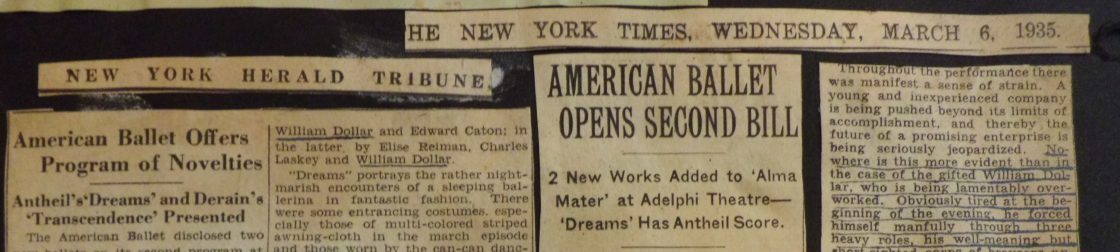
Kirstein did get his way and a school was made the centerpiece and start of his collaborative enterprise with Balanchine, and after a false-start in Hartford, Connecticut, the School of the American Ballet opened in New York at the very end of 1933, a couple months after Balanchine’s emigration from Europe. Balanchine made it clear through his words and actions, however, that making new work–like, you know, Serenade?–was his focus and he had no interest in the daily grind of barre routines or center work. In fact Balanchine’s focus on choreography (not pedagogy) and insistence on creating and presenting new work resulted in not just internal strife between him and Kirstein but less than ideal debuts for the performing arm of the enterprise, a company called the American Ballet. 

And yes, when I said “School of the American Ballet” in the paragraph above that was not a misprint, for that’s what the school was initially called. In other words, a performing arm was part of the enterprise from the very start–and this was Balanchine’s primary if not sole focus–even if it proved not a wise decision and the American Ballet would fold after only three years with not much to show for it. And indeed, throughout the first decade of Balanchine and Kirstein’s ballet endeavors, it is well documented that Balanchine’s focus was always on performance and not teaching. Other notable teachers were recruited to join the ranks of the school to fill this void, among them Pierre Vladimirov and Muriel Stuart, and for a brief time Erick Hawkins before he became partners with Martha Graham. Kirstein never lost focus on the school, however, rightfully understanding its importance over the long haul.

Why the focus on “But first, a school” and why has it been so important to insist that Balanchine said it? It’s a much better story of course, and sets up Balanchine to be the sole creative progenitor of the enterprise, the father of its school and creative choreographic genius all in one package. In religious terms it recalls the opening of the Gospel of John in which “in the beginning was the word and the word was with God” and everything flows from there. In more secular terms, it has echoes of Shakespeare’s memorable phrase about the performative powers of monarchical speech: “Such is the breath of kings.” This origin story is certainly easier than acknowledging the messier realities of the precarious early history of the organization and the all too human frailties and mistakes of its founders. It’s not as fun or awe-inspiring to to acknowledge that in the 1930s Balanchine was a young man lacking a certain amount of judgment and like most talented artists wanted to focus mostly on his own creative work, and he was open to the idea of a school if that’s what his American patrons wanted to do and if it could get his work back on stage.

Balanchine as the sole source and inspiration allows the School of American Ballet to claim a purity of lineage, and the New York City Ballet for its part can in turn stand as the ultimate vessel for his hallowed training organization. To be sure, SAB and NYCB have always nodded to Lincoln Kirstein when talking about their histories, but no one would argue that Balanchine remains the centerpiece of their collective brand. And with Balanchine having become perhaps the biggest global brand ever to exist in the history of ballet, how wonderful to be able to claim that your institutions exist all because of this one Great Man’s idea and all powerful utterance. Complicating these dynamics is the fact that Lincoln Kirstein himself was one of the purveyors of the “But first, a school” story, perhaps rightly understanding its power to create a sense of stability and even inevitability to what he knew had been an initially precarious and fragile enterprise. 

But as hard as it might be, letting go of this and other myths might allow ballet to evolve and let go of its patriarchal and monarchical instincts, in which founders and leaders are never questioned and as a result their worst tendencies can often run amok in the institutions for which they are responsible. I would argue that in large part because of the “But first, a school” mythology there was no question that after Balanchine’s death, his anointed successor Peter Martins of necessity had to be named the titular head of both “his” company and school. In the wake of Martins’ ungracious exit from both institutions, this concentration of power has at last been broken, with shared leadership across the company and school and the possibility for new transparency and accountability.

Balanchine never said “But first, a school” and thank goodness he didn’t because this founding myth does not stem from a value system that should be used to build (or rebuild) any institution. Because as much as maniacal focus and obsession (Kirstein) and genius and instinct (Balanchine) are important and deserving of respect if not awe, there is so much more that goes into healthy institutions if they are to survive, and there are even more hands and hearts needed to support them if they and the people they serve are to flourish and thrive. 

Serenade: A Balanchine Fever Dream

Toni Bentley has a new book out, called Serenade: A Balanchine Story, a title that matches its contents well. Although the book is autobiographical, the author’s personal experiences are intentionally sublimated to the “real” story: George Balanchine’s ascendance as the preeminent choreographer of the twentieth century, with the ballet Serenade posited as a sacred object that encapsulates the totality of his life and legacy.

This is a book written for the already-converted and has already won early praise from its intended readership, those who believe that Balanchine and his work are the most significant force in the last century of ballet. It will more than satisfy this demographic, especially those who have seen, or even better danced in, Serenade and other Balanchine ballets. The influential Kirkus Reviews explains how the book “endearingly captures her passion for ballet and the genius of a man who could incorporate a ballerina’s fall during rehearsal into a permanent part of his dance,” and lauds the book as a “heartfelt tribute to an influential choreographer and one of his crowning achievements.” Publishers Weekly notes that “her reverence for Balanchine’s genius is consistently moving” and the book’s “behind-the-scenes tour of a rarefied world will enchant ballet lovers.”

As someone who unlike Bentley was not brought up in the Church of Balanchine, but instead came to him later in life as an audience member and later researcher and writer, I find it hard to square these assessments of this book with the reality of its contents. For in the world conjured by Bentley, ballet and Balanchine exist in pure and unblemished glory, and if anything negative happened to her or other individuals it was all in service to this higher cause and evidently worth the pain and suffering. Of course, we know that all was never completely well in Balanchine land, whether in the form of his string of troubled marriages culminating in his tumultuous relationship with Suzanne Farrell, or the turmoil and abuse that took place under the leadership of his anointed successor, Peter Martins. Bentley seems unaware or uninterested in these matters, and even less interested in any of the wider critiques and reforms shaping discussions about the future of the art form, whether issues of physical and mental health or matters of race, gender, equity, and access. Bentley’s viewpoint is unabashedly nostalgic, an attempt to remember and recapture a lost paradise. Among other matters, at no point does Bentley acknowledge her position as a white woman, a status without which she would have had a much more difficult time entering into Balanchine’s sacred realm.

One immediate reaction to Bentley is to simply put the book down and not read any further, a decision for which I would not fault anyone, especially those who have been personally damaged or hurt by their time spent in ballet culture. For the wrong reader this book would be an extended exercise in gaslighting or even worse re-traumatization, depicting some of the worst practices and ideologies of ballet in glowing and approving terms with no regard to their potential impact on human lives. One can only hope that no young dancer will pick up this book and use it as a guide on how to conceptualize their relationship to the art form or their teachers and colleagues. 

Read against the grain, however, Bentley’s book can serve some purpose, as a cry for help or cautionary tale, an unwitting case study that might help diagnose many of ballet’s past sins and present ills. Indeed, if an author such as Chloe Angyal had articulated some of Bentley’s views as a foil to her own arguments about how ballet can and must adapt and change, she could have easily been accused of setting up a straw man, an overly caricatured representation of a contrary viewpoint. In this sense, Bentley has done ballet’s change agents a strange service, rendering in vivid detail and rich metaphor the rigid patriarchal world that many are trying to remake and reform.

*****

Bentley’s argument lies in its structure and rhetorical decision to tell three stories in one. The book moves seamlessly in and out of three modes: her own autobiography and encounters with Balanchine, a second-by-second close reading of Serenade (incorporating insights from teachers and fellow dancers), and excursions into ballet history (from Louis XIV to Marie Taglioni to Tchaikovsky and Serge Diaghilev). In the manner of Christian exegesis that elucidates the fulfillment of the Old Testament by the New, these parallel narratives mutually validate one another, leading to an unapologetic and triumphant teleology, with Balanchine the final consummation of ballet history and Serenade his most potent creation.

Balanchine looms large throughout all of these narrative modes. In the autobiographical passages he is depicted as a figure of benevolent holiness, erotic and romantic fascination, and cold judgement. His dancers are said to exist beyond the category of “gender” and instead are rooted in “vocation,” called “novices in Balanchine’s ministry.” While this might imply a chastity to the proceedings, these same dancers are taught to “turn the cheek as if waiting for a kiss. The kiss of fate, the kiss he might bestow.” What is not at all ambiguous, however, is the power that Balanchine wields in his world, and how this power is tied to feelings of love and fear: “As young girls, we are all scared of him–he has the love we want, the only love we want.” Serenade is an exercise in initiation (one almost wants to say grooming), posited as “a dance of the young, by the young, many still virgins–I certainly was one.” If a dancer is to make a mistake in this sacred rite, there is no way to atone for it, as even an apology to Balanchine will not be accepted. “You can’t mess up the ballet, dear,” he reportedly says after one such futile attempt, a somewhat detached and almost inhuman response to such a perilous moment for the dancer in question. This miasma of innocence, eroticism, and power is not regarded as anything troubling, however, but rendered as a treasured feature of Balanchine’s world. 

Initiation into this world happens at an early age, and in Bentley’s case began during her student years as a dancer drawn from the ranks of the School of American Ballet during rehearsals for Nutcracker, when she first “laid eyes” on Balanchine. He evidently treated children with unaccustomed “respect and kindness,” and in return they would grow over time to think of him as the lodestar of their entire existence, inspiring everyone to give over their entire selves in exchange for being shaped in his image:

“And so it was here that the love for Balanchine began. Just how much a little girl wants to please that man of authority can never be measured. Looking at the devotion, sacrifice, time–their entire youth–and beauty Balanchine’s dancers gave him is one way to see the depth. But what is even harder to grasp is the breath of what he gave us. So much more than a benign father, he offered life itself, a life not a single one of us would have had otherwise.”

In moments like this in the book I found myself turning back to the previous paragraphs to be reminded what the point of departure was for these moments of ecstatic reverie. In this case it was Bentley being allowed to don a pink and green striped jumpsuit adorned with bells while carrying a similarly decorated hoop as backup to the male soloist in the “Russian” divertissement in the second act of Nutcracker. While I would be the last person to disparage the magic of Nutcracker, the fact that sixty seconds on stage can be construed as a reason to pledge one’s entire life to the man who made the steps is the kind of thinking that ballet should be moving away from, not running towards. 

*****

Serenade is a ballet deserving of sustained critical attention, as a beautiful work of dance and one of the earliest ballets by Balanchine to have remained in continuous performance. It is famously lauded as Balanchine’s “first ballet in America,” a status that despite being easily problematized has stuck to the work as tenaciously as a Homeric epithet. Bentley is not interested in the more complicated history of Serenade (despite including recent scholarship in her bibliography), which at the start of Balanchine’s time in the US was emblematic not of his inevitable triumph but indicative of how much he still had to learn and how far the ballet enterprise he created with Lincoln Kirstein had to go. 

In Bentley’s hands Serenade becomes laden with an overwhelming web of metaphors and meanings, especially ironic for a ballet by Balanchine, who famously dismissed any complicated takes on his work as “too fancy.” Diagrams of the ballet’s movements made by John Taras are likened to da Vinci’s Vitruvian Man, “converting spirit to physics and then, onstage, back again.” One moment in the ballet is likened to Stonehenge, “an outdoor temple of secret ceremony, worship, death, resurrection, and astronomy.” With respect to the past, Serenade is posited as the uncritical consummation of all ballet history. Hearkening back to the aristocratic ballets of Louis XIV, it reveals ballet transfigured in democratic garb–“an uncorrupted aristocratic art form no longer defined by birth, a difficult but attainable democratic nobility”–a questionable claim in light of the art form’s ongoing problems of access. Serenade also is said to connect all its dancers with the originator of pointe technique, Marie Taglioni, with Bentley inviting the reader to “look inside any well-anointed pointe shoe and see the bleeding beauty that connects us all to her,” not interested in questioning why young women are pushed into pointe shoes at such an early age, much less asking whether dancers of all gender identities might be allowed on pointe. Perhaps most disturbing and in line with its status as a dance of initiation for young female virgins, Serenade is “a labyrinth that Balanchine has constructed to guide us, gently, but with no recourse but to proceed,” hardly sentiments that one would hope to hear articulated by any young person regarding their ballet teacher or any authority figure in 2022.

That the book’s contents passed muster with multiple editors and critical gatekeepers without any objections is regrettable but sadly not surprising, as there is no doubt a large and ample market for the kind of uncritical nostalgia. To that end, I can already hear the objections to some of these observations, likely some version of 1) “well if you had been there you would understand,” 2) “why do you think you know better than her?” or 3) “oh it’s just harmless connoisseurship dressed up in somewhat overdetermined prose, what’s the big deal.” 

But as Balanchine famously stated once to an eager mother, ballet is a moral endeavor, and the world depicted by Bentley is not the world that I would want any dancer to enter into or aspire to join. Throughout this book I frequently recalled the moment in the documentary Dancing for Mr. B when Darci Kistler catches herself almost mid-sentence in a moment of embarrassed self-awareness to note, “I feel like I’m talking about a religion.” If Balanchine is indeed a religion, Bentley’s book was written to be added to its sacred scriptures. It’s too bad that no one bothered to tell her that the equivalent of Martin Luther’s theses were posted on ballet’s door some time ago. One can only hope her book doesn’t do anything to stall the reformation, if not the revolution, that is well underway.

Tiny Pretty Things: The Melodrama that Ballet Deserves

(No spoilers except for one that doesn’t really count but I flag it anyway!)

I waited until after finishing the final episode of Tiny Pretty Things to read reviews online, and was not entirely surprised by the reactions. There was the predictable highbrow takedown in the New York Times, whose main advice was “don’t bother,” expressing utter shock–and we are talking pearl clutching *shock*–that a Netflix melodrama about young dancers would include so much sex. There was a more positive but still lukewarm review in the Guardian that basically called the show harmless fun, and various other perspectives that lamented the show’s uneven acting and excessive and confusing subplots, comparing it (mostly unfavorably) to the likes of Centerstage or Fame.

In fact, the show owes more to How to Get Away with Murder than the likes of Centerstage, and indeed many elements seem like a clever “save as” of the Viola Davis hit: a diverse cast of young, talented, attractive students; antihero adults with their own bad habits and secrets; dark and brooding interior spaces; a fast-paced and high stakes professional environment; and excessive and sometimes confusing subplots. And yes, like so many successful tv melodramas, there is a lot of sex: sex between the students, sex between the students and some of the adults, and sex between the students and other non-students, with a lot of the sex taking place in dark and brooding interior spaces fuled by the pressures of the fast-paced and high stakes environment in which the students and adults find themselves and occasioned by the excessive and sometimes confusing subplots. 

If you aren’t able to take pleasure in what Tiny Pretty Things is, it’s not surprising that you’ll miss out on some of the interesting dynamics and messages lurking beneath all the sex, drugs, violence, and everything else that compels us to binge watch tv melodramas. To put a finer point on it: faulting the show for too much sex or unbelievable plot twists and soap-opera acting is missing the point, because mixed in with the melodramatic tropes is some good dancing as well as a not entirely unrealistic depiction of some of the not so pretty realities of the culture of contemporary ballet pedagogy and performance. 

As was the case with Mozart in the Jungle, which pledged allegiance to classical music in the form of celebrity cameos and other insider nods, Tiny Pretty Things creates a pretty believable version of the world of ballet, in no small part thanks to the core cast of actors who do their own dancing. This means no editing is necessary as the students move seamlessly from dancing to other activities, and it also means we get to see a lot of actual dancing in every episode, something in short supply on mainstream platforms. By making this choice the creative team perhaps knew they were creating a critical Catch-22, that is, by casting dancer-actors you are not likely to get either the very best actors or the very best dancers, since almost no one falls into that narrow category. It’s baffling that no one acknowledges this simple fact when critiquing the show’s acting or dancing, but for me the pleasure of seeing a “real” cast of dancers was enough to look past anything else.

The writers and producers were smart to add real-life and big-name ballet ethos to the proceedings, tapping none other than Tiler Peck to pop in for a few episodes. Peck plays a version of her actual self: an accomplished soloist and choreographer who has embraced her celebrity to popularize ballet and is coming to cast students from the Archer School in a special music video project. As in other moments in the show, Peck’s appearance includes a few well chosen turns of phrase only obvious to the initiated, such as when she is convincing one of the students to join one of her projects, as she says that it will be like “when Misty toured with Prince.” Peck’s acting will not likely get her an Emmy, but that’s why I loved her even more for appearing in the show. Having Tiler Peck giving a Charlize Theron-level performance was not the point. Just like her character’s interest in embracing popular media, Peck was willing to run the risk of appearing in the show since it might help a few people get interested in ballet or facilitate a conversation about how it needs to change, and her character arrives as an embodiment of positive energy and change.

Peck serves as a crucial foil for perhaps the most interesting character and the beating heart of the plot, the tragic figure who leads the Archer School, Madame DuBois. “Madame,” as she is known to all characters regardless of their status in the ballet hierarchy, does not seem to even have a first name, which is perhaps her character’s most perfect trait. Fully embodying if not metaphorically consumed by her cosmopolitan honorific, Madame is the product of a system in which she now wields supreme power, and as a result she is by turns feared, revered, loved, hated, flattered, and undermined, sometimes in the same scene or even the same sentence. In the later episodes a few layers of the onion are peeled back, allowing us to understand how much she had to give up to be “Madame” and making us understand how hard she had to fight to maintain her arcane parochial status and title.

Madame has a killer wit and an even more killer body even as she has long left a career on the stage behind, turning out looks and phrases that would make the shadiest drag queen snap and giving off Showgirls or Dynasty levels of power campiness. It’s never fun to realize that an accomplished female lead character has become so accomplished despite (or more often because of) some profound traumas and tortured compromises, but in this sense Tiny Pretty Things is keeping things real. Unlike the anachronistic feminist holograms on other streaming shows (looking at you, Mrs. Maisel and Patti LuPone in Hollywood) Madame DuBois might at least help us continue to grasp why Hillary Clinton is not settling into her second term as the forty-fifth President.

Let’s also acknowledge that if honorary degrees were awarded for passing the Bechdel Test, Tiny Pretty Things would earn a Ph.D. Relationships and scenes between women abound, among the students, between dancers and mothers, and of course between Madame and students and parents. A healthy percentage of the named male characters are not heterosexual, and the excessive sex scenes include some quite revealing male-male action. And while Madame is certainly not on the side of the angels, the people perpetrating the truly terrible things are mostly straight white dudes with gay and lesbian characters mostly there to right wrongs or at least mitigate the damage. 

Don’t get me wrong, there is also a lot to criticize about this show. The show indulges in some lazy and problematic tropes with respect to race and to a lesser extent class. Did the most layered black character really have to have the only mother in the show to have spent time in prison and a brother who is in a wheelchair? Did the other significant black character have to have a southern accent with no real backstory to go along with it, making it seem as authentic as a sombrero on Cinco de Mayo? Did the one Muslim character need to be portrayed with Homeland levels of mysterious brooding and danger? And when one of the main (white) characters seeks refuge from the toxicity of the school and her frosty WASP mother (who happens to be the chairman of the board) did she really have to go to a working class Little Italy style famiglia where the mother is always stirring sauce with one hand and drinking red wine and gesticulating emphatically with the other, all while her sensuous dark-haired children who are more in touch with their feelings and bodies dance to old-time popular music in the living room? In the end, Tiny Pretty Things fails to decenter the whiteness that is regrettably still at the core of ballet, which in some ways makes it a more timely and accurate barometer of the state of the art form. Because this is a melodrama and everything has to be on the surface, the show at least is obliged to throw these terrible dynamics into vibrant relief, as the diverse cast of dancers literally do battle against the corrupt white power structure. 

Indeed, halfway through the series in a somewhat throwaway scene, the detective attempting to unravel the core crime at the heart of the plot, and who happens to be a lesbian, almost throws in the towel, confessing that she thought by investingating the rules, order, and chain of command in ballet that it would help her “tease out the mysteries of another world [the US military] that still puts down women and silences dissent and controls the every waking moment of anyone dumb enough to walk in and join up.” Her commanding officer (a white guy, of course), makes an appeal to reason, telling her that “Ballet’s got nothing to do with what happened to that girl!” Her impassioned response made me clutch my pearls more than any of the show’s sex scenes: 

[Spoiler coming but not really since it’s pretty much revealed in the first five minutes of the show.]

“[Ballet] has everything to do with it, Dan. It’s not just one person who threw Cassie Shore off that ledge. It is four hundred years of this twisted, beautiful art form that the western world conspired to create. I have fought a lot of things, but I don’t have it in me to fight this.”


If nothing else had rung true in all of Tiny Pretty Things, the detective’s brief monologue had me nodding vigorously alone in front of my bourbon. My first thought was, yeah you got that right, detective, and I bet you haven’t even seen La Bayadère. And my second thought was that this must be a version of what Phil Chan or Chloe Angyal has to scream into their pillow or scrawl into their journals on a weekly basis. In other words, despite its faults, like so many problematic objects–including ballet itself–Tiny Pretty Things contains the kernels of its own critique. In fact, the inability of the show offer a nuanced depiction or actual critique of ballet is perhaps its most profound contribution to conversations about the art form today. Tiny Pretty Things may not be the melodrama that ballet wants, but it’s the one that it deserves.

Ugly Crying at Hamilton, and Uglier Crying over U.Va. and *Thomas Jefferson’s Education*

As a graduate of the University of Virginia who relished the beloved traditions of my alma mater, I’m grateful that one of its own professors, Alan Taylor, has chosen to take as an object of inquiry the founding and founder of the school itself. Thomas Jefferson’s Education is a timely and necessary corrective to the received wisdom eagerly and uncritically promulgated during admissions tours and which suffuses so many of the University’s cultures and traditions, whether the irrational worship of its architecture or obsession with Edgar Allan Poe. If like me you thought the one of the more unseemly things to have happened in the history of U.Va. was the habit of interjecting the phrase “not gay” into the Good Ol’ Song, you are in for a big reality check.

I began Taylor’s book while on vacation in February 2020 and picked it up again over Fourth of July weekend, realizing that the need for personal re-education about American’s past could no longer be put off. And with Hamilton suddenly available for streaming and on everyone’s mind again I was also newly curious to see a Pulitzer-Prize winning historian provide some real talk about a Founding Father.

A few quick caveats about Thomas Jefferson’s Education if it wasn’t already becoming clear:

  1. If you are looking for a straightforward chronological history of the University of Virginia this is not the book for you.
  2. If you are seeking to read about how brilliant and amazing Thomas Jefferson was, this book is also not for you.
  3. If, like me, you were crying like a baby while watching Hamilton stream on Disney Plus because man, you didn’t realize how much you needed to be reminded that America can produce things that are powerful and beautiful, BUT you felt a twinge of guilt as you choked back tears because you knew full well that it glosses over a lot of the Bad Stuff – in part through its jocular treatment of Jefferson – this book could be the thing for you. (Of course as soon as you’re done you can watch Hamilton a second or third or fourth time and cry over its power and beauty.)

Taylor’s book offers a fascinating and unabashedly granular deep dive into the political and economic dynamics of colonial and post-Revolutionary Virginia. Like much of America, Virginia was built by the enslaved labor of African Americans, and along with many other aspects of the state Jefferson used the profits of this uncompensated work – along with his charm, power, and influence – to shape the character of its educational systems, culminating in the unlikely and chaotic founding of U.Va. Taylor offers an honest and unvarnished take on Jefferson and the men and women who surrounded him. Hewing closely to sources, Taylor is attuned to Jefferson’s contradictions and faults and metaphorically takes him down off of the pedestals on which we often encounter him, including on the Grounds of U.Va. itself. Thomas Jefferson’s Education is compelling but not light reading, and the play or musical it might inspire would more likely be commissioned by the Volksbühne than the Public Theater.

As a white person seeking to re-educate himself about US history and the legacies of racism and white supremacy I am especially grateful to understand the problematic history of the college that educated me. I was shattered to learn details of the myriad ways that enslaved African American workers suffered to produce capital for the landed classes, including but not limited to the construction and operation of the buildings in which my fellow students and I studied and lived at U.Va. Among the many heartbreaking passages was the following detail about early medical education at U.Va.: “Not even death could end coerced service by enslaved people to the University. At night, medical students exhumed recent graves of slaves to get cadavers for dissection and study.” This macabre incident would be troubling enough as the subject of an entire chapter, and is all the more disturbing as the brief concluding moment of a litany of other abuses and horrors.

Taylor is a measured and meticulous historian and his book is all the more devastating and convincing thanks to his even-handed approach. This book is far too methodical to be construed as any sort of explicit call to action. Nevertheless, its findings have reoriented me about the truth about my college and I suspect would have the same effect for other alumni and current students. Armed with Taylor’s insights I feel empowered to demand that my school acknowledge the ugly truths about its history rather than celebrate what I now realize are fantastical and in fact damaging mythologies about its origins, especially but not limited to tales of its troubled “founder.”

Reading and Watching Mark Morris, Pre- and Post-The Stuff

When and how to pick up much less finish a book is always a mixed bag, especially when the collapse of the world order and the rapid transformation of art forms you’ve devoted your life and career to are playing out at the same time. As the memes have reminded, 2020 has already done a number on all our plans, but I finally caught up on some of my dance reading goals.

Since since March 6 when I last saw a live dance performance – the first and only performance of Balanchine’s A Midsummer Night’s Dream by San Francisco Ballet, which was as perfect as one could hope for – I finished several dance books. I hadn’t intended to read any of these as a way of navigating the strange moment we are living through, and yet like everything these days, you can’t help but process everything through a COVID lens.

Here’s the first in a series of dance reading reports.

Mark Morris and Wesley Stace, Out Loud: A Memoir

Like all memoirs, Mark Morris’s memoir was always already going to be suffused with nostalgia, and the book catalogs with care and and even more careful score-settling his many interactions with family, partners, lovers, enemies, frenemies, collaborators, patrons, and critics. The book now almost reads like a report from an alien world, when people travel and perform for large groups of in person audiences and hold rehearsals and celebrations in cramped interior spaces.

Out Loud is everything one might expect from an iconoclast who finds himself about as firmly ensconced in the arts establishment as is possible. Indeed what’s so fascinating about Morris’s career–and why it’s thrilling to read about it in his own (openly ghostwritten) words–is the incongruity of his outsider ethos and his Great Artist stature. You can give him MacArthur grant and put his name on a building across the street from BAM, but Morris still insistently inhabits an outsider position, the precocious queer kid from Seattle with musically omnivorous taste who couldn’t be bothered to finish high school and now has a half dozen Ivy League honorary doctorates.

And yet, for many decades Morris’s stature has been anything but incongruous with his ethos. In fact his stature, almost to his chagrin, it seems, has become inseparable from his ethos. Morris finds himself as one of the Last Great Choreographers of Modern Dance, one of the few canonical exponents of an art form that will not be canonical for too long, since we are finally getting over our addiction to canons. In this light, it’s equal parts cringeworthy and satisfying to hear Morris rail against political correctness and say that he doesn’t know why people freak out about bullying in schools because he is grateful he got roughed up (!?) because it made him figure out who he was. The fact that a radical outsider can end up as a grumpy old man screaming from the front porch is, at least for me, a weirdly hopeful message about how the center and periphery can shift in the course of one person’s lifetime.

As an arts administrator and collaborator, I was grateful to see Morris grant significant airtime to many key players who contributed so substantively to his success. Among them are dancer Tina Fehlandt, one of the founding members of Morris’s dance group, the originator of dozens of his most iconic roles, and now responsible for staging his dances on companies all over the world. MMDG Executive Director Nancy Umanoff also is given her due, given credit for everything from crisis management to capital fundraising and everything in between. I suspect that Nancy is presently working harder than ever and I hope that Tina will be back to work on the stage soon.

Earlier this year San Francisco Ballet performed Morris’s Leroy Anderson-scored Sandpaper Ballet, and on opening night I happened upon the Great Man himself in the lobby in the last moments of intermission. I briefly said hello and told him how much I was looking forward to Sandpaper. He was gracious but of course his parting words were, “Enjoy my ballet, or else!” delivered with a smile and a vigorous wag of the finger. Of course like everything Morris does, this phrase was delivered with deadly serious playfulness, and I knew I was going to enjoy the ballet before he told me I had to. (And of course I did.)

Prior to this encounter I had overheard other patrons discussing Out Loud, specifically the passages towards the end when he discussed the choreography he has prepared to be performed after his death. In our innocent pre-COVID bubble this endeavor seemed to be raising eyebrows and eliciting amused eye-rolling if not pearl-clutching. “I mean, that’s just so morbid and who does he think he is?” Of course nowadays it seems like a concept that’s nothing short of genius. Let’s hope that we don’t see those dance anytime soon and that Morris and Nancy and Tina are all washing their hands and resting up for whatever is to come.

Lincoln Kirstein’s Modern: A Short Biography and Syllabus

Upon the occasion of the newly-opened exhibit at the Museum of Modern Art, Lincoln Kirstein’s Modern, below is a short introduction to his remarkable life and work, and a list of writings by and about him.

Lincoln Kirstein (1907–1996) possessed a seemingly unlimited reserve of energy and ideas, and the quantity of his many unrealized endeavors is as noteworthy as his successes. It was in this expansiveness of imagination and willingness to put his artistic convictions into action that his true genius lay, no matter the obstacles or potential for failure. He thrived when at his busiest and was constantly engaged in multiple projects, all the while dreaming up new ones for the future. It is difficult to say exactly whence this disposition arose. To some, it was in part a product of his family’s wealth and connections—the unfettered mindset of individuals with significant financial resources at their disposal. Others posit psychological origins, pointing to his history of manic episodes and bipolar tendencies, or argue that he was able to get by on very little sleep. Whatever the cause of his passion, Kirstein was one of the most active and generous advocates on behalf of modernist expression in the twentieth century, in virtually all of its generic manifestations.

Kirstein was born in Rochester, New York, and was raised among the wealthy elite of Boston. His mother, Rose Kirstein née Stein was from a prosperous Rochester family; his father Louis Kirstein was a successful businessman—most notably as a partner in the Filene department store company—and a dedicated philanthropist whose sense of noblesse oblige would greatly influence his son. His parents, as well as his sister Mina Curtiss and brother George Kirstein were generous supporters, financially and personally, of his many artistic and organizational endeavors throughout his life. Kirstein attended the Berkshire School in western Massachusetts, and subsequently enrolled at Harvard University, graduating in 1930.

Kirstein’s parents were relatively unobservant Jews, although active in Jewish political and philanthropic causes, and his religious upbringing was nominal. In high school he was introduced to the practices of the spiritual teacher George Gurdjieff, who would prove a strong influence, especially in Kirstein’s early adulthood. In his later years he became interested in Roman Catholicism, although he never took any formal steps toward conversion. In 1941 Kirstein married Fidelma Cadmus, sister of his friend, the painter Paul Cadmus, and was a devoted husband until her death in 1991. He maintained numerous passionate relationships with men throughout his life, both sexual and nonsexual, but never explicitly identified himself as homosexual.

During Kirstein’s time at Harvard, his primary interests were literature and the visual arts. He wrote several books of poetry and an autobiographical novel, Flesh is Heir, published in 1932. Of more lasting significance than his own work was the literary quarterly Hound & Horn, which he co-founded in 1927 with Varian Fry and R. P. Blackmur. Modeled on T.S. Eliot’s The Criterion, the journal would in its seven years of existence publish original work by American modernist writers such as Katherine Anne Porter, e. e. cummings, William Carlos Williams and James Agee. Kirstein himself contributed two major articles on ballet, his earliest writings on dance.

During this same period, Kirstein and fellow students Edward M. M. Warburg and John Walker III, under the influence of Harvard professor Paul Sachs, organized the Harvard Society for Contemporary Art. The Society mounted several shows of work by living artists, which met with indifferent to indignant reception among Boston’s conservative art patrons. Although short-lived, the Society provided the organisational nucleus of the institution that would become the Museum of Modern Art in New York City. Although he never functioned in a leadership capacity, Kirstein would maintain close ties to MoMA. He was responsible for numerous exhibitions and the accompanying catalogues, including a 1932 exhibition of contemporary mural painting and a 1948 retrospective of Polish artist Elie Nadelman. He would continually advocate for the acquisition of more work by American artists and helped broker many relationships between the museum and artists whom he championed. In 1939 he donated his significant private collection of books, prints and dance memorabilia to the museum to establish the Dance Archives, the first such scholarly resource in the United States.

Kirstein had a long interest in ballet, particularly in the Ballets Russes and its founder and artistic director, Serge Diaghilev, on whom he modeled his own career as an impresario. He made yearly visits to Europe beginning in the 1920s and saw performances of Firebird and ballets by Léonide Massine and Balanchine. Through his friendship with Romola Nijinsky—for whom he served as ghost-writer for significant portions of her biography of her husband, Vaslav Nijinsky—Kirstein gained access to the circle of Russian émigré dancers and choreographers, including Balanchine. With Balanchine somewhat institutionally adrift since Diaghilev’s death in 1929 and the onset of the Great Depression, Kirstein found the choreographer receptive to the idea of coming to the United States to start a new company. Kirstein brought Balanchine to the United States in October 1933.

In the fifteen years following Balanchine’s arrival, the organization envisioned by Kirstein would assume many forms. Crucial to the enterprise in all of its incarnations, however, was the continuous presence of a training institution, the School of American Ballet (SAB), which opened its doors at a studio on Madison Avenue shortly after Balanchine’s arrival. Students from SAB first performed in June 1934 at a private performance at the estate of Felix Warburg in White Plains, New York—including the ballet Serenade, the first original work created by Balanchine in America. The company made its debut as the American Ballet in March 1935 at the Adelphi Theater on Broadway, garnering the notice of the new head of the Metropolitan Opera, Edward Johnson, who invited the group to become the Met’s resident ballet troupe. The arrangement would prove uncongenial and lasted only three years, but it did allow the fledgling organization to mount several significant performances: an all-Stravinsky program—conducted by the composer himself—that featured the American premiere of Balanchine’s Apollo­; and a dance-intensive staging of Gluck’s Orpheus and Eurydice designed by the artist Pavel Tchelitchev, of whom Kirstein was a devoted patron. Kirstein articulated his frustrations with the Met, as well as his larger critique of the hegemony of Russian ballet in America, in his 1938 pamphlet Blast at Ballet.

Concurrent with the American Ballet, in 1936 Kirstein formed a second troupe called Ballet Caravan, conceived as a summer touring company (and confidently posited in Blast at Ballet as an antidote for the degenerate state of ballet in America). The Caravan allowed Kirstein to pursue more directly his vision of a company with a distinctly American profile, and afforded him an active, all-encompassing role as producer, allowing him to commission original music and designs from artists of his choosing. The dancers themselves created the choreography, in collaboration with a distinguished roster of American writers, composers, and artists, including Paul Cadmus, Ben Shahn, Aaron Copland, Paul Bowles, Florine Stettheimer and Virgil Thomson. Although the troupe did not survive the 1930s, the Caravan provided important exposure and choreographic experience for dancers such as Ruthanna Boris, Lew Christensen, William Dollar, and Eugene Loring. The Caravan was also notable for being less focused on classical ballet, and organisationally and aesthetically represented a rapprochement by Kirstein with the world of modern dance, towards which he was generally unsympathetic. True to its name, the Caravan was always somewhat makeshift in its organization and execution, and only two of its ballets—Billy the Kid and Filling Station, for which Kirstein himself wrote the scenario—garnered significant critical and popular acclaim.

In 1941 Kirstein and Balanchine formed the American Ballet Caravan, combining their two previous ventures for an extended tour of Latin America, funded by the State Department’s office of Inter-American Affairs, headed by Kirstein’s long-time friend and patron Nelson Rockefeller. The goal of the tour was to promote goodwill and counteract the region’s growing pro-Nazi sentiment. Kirstein returned to South America the following year, again at the request of Rockefeller. His official mission was to purchase new work by Latin American artists to augment the collections of the Museum of Modern Art—of which Rockefeller was President—but the real purpose was to gather off-the-record political intelligence.

Following a stint in the army, Kirstein’s next major undertaking was Ballet Society, created in 1946 and conceived as a non-profit membership-based subscription organization. As with Ballet Caravan, Kirstein held primary responsibility for both artistic and administrative planning and commissioned librettos, music, scenery and choreography from a wide range of artists, many of whom had been involved in his previous endeavours. Although Balanchine was not a central institutional force behind Ballet Society, he was a key collaborator for two of its most important works: The Four Temperaments, to a score by Paul Hindemith, commissioned personally by Balanchine several years earlier, and featuring elaborate costumes by Kurt Seligmann (subsequently abandoned in favour of simple practice clothes); and Orpheus, to a newly-commissioned score by Stravinsky, with designs by Isamu Noguchi (a frequent collaborator of Martha Graham) and starring Maria Tallchief, Tanaquil Le Clerq, Nicholas Magallanes and Francisco Moncion. Although its performances were critically acclaimed, Ballet Society was never self-supporting, despite its non-profit status and substantial personal contributions from Kirstein and other patrons. In 1948, however, when its demise seemed inevitable, the chair of the executive committee of New York City Center, Morton Baum, invited Ballet Society to become the resident ballet company of the city-operated venue. Thus the Kirstein and Balanchine enterprise finally achieved institutional permanence under the new identity of the New York City Ballet.

Although City Center provided the company with a more stable institutional base and covered day-to-day operating costs, there were few funds available for the creation of new work, and Kirstein continued to support new productions from his own funds and by soliciting donations from patrons. In 1952, Kirstein became Managing Director of City Center, and during his tenure secured a grant from the Rockefeller Foundation to support new opera and ballet productions. A committed leftist throughout his life, Kirstein was a strong supporter of the Civil Rights movement and participated in the 1965 march in Selma, Alabama, later writing a poem about the experience. He helped numerous African-American dancers, especially men, gain admission to SAB in the 1940s and 1950s, and supported NYCB principal dancer Arthur Mitchell in founding the Dance Theater of Harlem.

As a member of the Lincoln Center planning committee Kirstein was instrumental in ensuring the company’s permanent home at the New York State Theater and SAB’s inclusion in the complex. In 1959 the Ford Foundation, at Kirstein’s urging, made a major grant to SAB that made possible national audition tours and an expanded scholarship program, effectively transforming the organisation into America’s leading training academy for ballet. This position was further strengthened in 1963 when Kirstein secured a second major commitment from Ford, a multi-million grant in support of a half dozen American ballet companies, the bulk of which went to support NYCB and SAB. Until his death, Kirstein served as the guiding institutional force of both organizations and of dance in the United States more broadly.

Alongside and frequently in tandem with his undertakings, Kirstein was a prolific writer, as notable for his many published books, articles, program notes and prefaces as for his prodigious personal correspondence and diaries. As a critic, historian and collector he played an essential role in the professionalization of the study of dance in the United States, not simply as an artistic practice but as a subject of intellectual study. As the founder of Dance Index, Kirstein oversaw the first scholarly journal in America devoted to dance. His work on Nijinsky helped to secure the dancer’s place in the history of ballet as more than an idiosyncratic performer and reasserted the place of male dancers in the history—and future—of ballet. His historical and critical writings are at once indispensible scholarly references and important primary sources in their own right, documenting the development of ballet and dance in the twentieth century. In addition to his donations to MoMA and the Metropolitan Museum of Art, his personal papers and other collections constitute some of the most significant archival holdings of the New York Public Library’s Jerome Robbins Dance Division.

Selected Writings

Kirstein, Lincoln. (1983) Ballet: Bias & Belief—Three Pamphlets Collected and Other Dance Writings of Lincoln Kirstein, New York: Dance Horizons, Inc.

—. (1991) By With To & From: A Lincoln Kirstein Reader, Ed. Nicholas Jenkins, New York: Farrar, Straus & Giroux.

—. (1935) Dance: A Short History of Classic Theatrical Dancing, New York: G. P. Putnam’s Sons. Reprinted 1987, with an appreciation by Nancy Reynolds, New York: Dance Horizons, Inc.

—. (1994) Mosaic: Memoirs, New York: Farrar, Straus & Giroux.

—. (1970) Movement and Metaphor: Four Centuries of Ballet, New York: Praeger.

—. (1975) Nijinsky Dancing, New York: Knopf.

—. (2009) Program Notes, Ed. Randall Bourscheidt, New York: Eakins Press Foundation and Alliance for the Arts.

—. (1978) Thirty Years: the New York City Ballet, New York: Knopf.

References and Further Reading

Duberman, Martin. (2007) The Worlds of Lincoln Kirstein, New York: Knopf.

Garafola, Lynn, Ed., with Eric Foner. (1999) Dance for a City: Fifty Years of the New York City Ballet, New York: Columbia University Press.

Garafola, Lynn. (2005) “Dollars for Dance: Lincoln Kirstein, City Center, and the Rockefeller Foundation” in Lynn Garafola (2005) Legacies of Twentieth-Century Dance, Middletown, Connecticut: Wesleyan University Press, 305–16.

Harris, Andrea. (2017) Making Ballet American: Modernism Before and Beyond Balanchine, New York: Oxford University Press.

Kayafas, Peter, Ed. (2007) Lincoln Kirstein: A Bibliography of Published Writings, 1922–1996, New York: Eakins Press Foundation.

Reynolds, Nancy. (1999) “In His Image: Diaghilev and Lincoln Kirstein” in Lynn Garafola, Ed., with Nancy Van Norman Baer, The Ballets Russes and Its World, New Haven: Yale University Press.

—. (1977) Repertory in Review: Forty Years of the New York City Ballet, New York: Dial Press.

Steichen, James. (2018) Balanchine and Kirstein’s American Enterprise, New York: Oxford University Press.

Weber, Nicholas Fox. (1992) Patron Saints: Five Rebels Who Opened America to a New Art, 1928–1943, New York: Knopf.